Historically, during bad economic times, it is the entertainment industries that flourish - presumably, because people want to forget about their financial woes and drown themselves in happy distracting entertainment. Going to the movies is a good way out. And today, films are more accessible and available via NetFlix, video stores, and now online, meaning it doesn't break the bank no matter what age you are, or how bad off things are financially.
Here is another interesting tidbit. Fifteen years ago, the Sundance Film Festival got 500 submissions. This year, they received 5,000. Virtually all of these are privately financed films. Yet Mark Gill, who recently addressed an audience of film making professionals at the Los Angeles Film Festival, sited that Disney has gone from releasing 47 films in a year not too long ago to putting out only 12 films this year. Many of the “independent” branches of the studios have either been shrunk or dissolved altogether.
Gill also said, “If you want to survive in this brutal climate, you’re going to have to work a lot harder, be a lot smarter, know a lot more, move a lot faster, sell a lot better, pay attention to the data, be a little nicer, trust your gut, read everything and never, never give up.”
Yes, the competition is tough, and economics are making things challenging, but it is also a time where creative people can learn and seize their full potential, both now and later on.
That said, one also might wonder how this economy has effected the film school business, or those interested in programs at recording schools or radio schools for that matter. Because their mentorship programs are so reasonably priced, the Entertainment Career Connection's alternative film schools are really valuable, because people actually get jobs after they complete the programs - 74 percent to be exact. And, there has been a big increase in those taking the company's courses since January 2008. Student registrations in film, radio and recording are running about 160 percent over January 2008 -meaning the increase in the number of people who want to learn how to be a film director, or sign up for an audio engineer program or even those who want to learn to be a sports announcer, has been substantial.
Showing posts with label learn how to be a film producer. Show all posts
Showing posts with label learn how to be a film producer. Show all posts
Monday, October 13, 2008


Friday, October 3, 2008
Second Life and Educational Trends in Filmmaking
Have you ever heard of 'Real Life Education in Second Life.' This group is made up of people who are interested in the educational possibilities of Second Life where they say there are more than 400 universities and 4,500 educators participating in the Second Life Educators List (SLED). They are learning how to leverage the benefits of learning in a virtual world in order to assist the students of today.
 In the photo: Second Life students role-play a courtroom scene hosted by Peggy Sheehy in Teen Second Life. How cool is that?
One article written by a professor of computer science at Colorado Technical University named Cynthia M. Calonge says, "the benefits outweigh the risks associated with venturing into a virtual world educational platform. For me, the virtual world is my preferred learning and teaching environment."
This method combined with a mentorship program may be the best way to learn in the future. As students learn and participate in social networks, such as our own Entertainment Connection Media Warrior network, they will benefit as they learn the importance of promoting themselves online, while they take our Film-Connection course where they can learn how to be a director.
Today, blogs are becomming a way of life. Everyone's on MySpace, FaceBook, and now Twitter, so imagine the magnitude of virtual classrooms? It would be one way to learn the bookwork in a fun and inspiring way, then go work with your mentor in the real world, at a real job, in training.
The author of The Extreme Future, James Canton, said that one of the top ten industries of the innovation economy is, "8. Education and Learning. The creation of immediate, portable, transferable, on-demand knowledge sources on a scale equivalent to the Library of Congress."
Well, virtual life is not far away as everything is transferred over to the Internet via Web 2.0. watch for 3-D on the Web in Web 3.0.
 In the photo: Second Life students role-play a courtroom scene hosted by Peggy Sheehy in Teen Second Life. How cool is that?
One article written by a professor of computer science at Colorado Technical University named Cynthia M. Calonge says, "the benefits outweigh the risks associated with venturing into a virtual world educational platform. For me, the virtual world is my preferred learning and teaching environment."
This method combined with a mentorship program may be the best way to learn in the future. As students learn and participate in social networks, such as our own Entertainment Connection Media Warrior network, they will benefit as they learn the importance of promoting themselves online, while they take our Film-Connection course where they can learn how to be a director.
Today, blogs are becomming a way of life. Everyone's on MySpace, FaceBook, and now Twitter, so imagine the magnitude of virtual classrooms? It would be one way to learn the bookwork in a fun and inspiring way, then go work with your mentor in the real world, at a real job, in training.
The author of The Extreme Future, James Canton, said that one of the top ten industries of the innovation economy is, "8. Education and Learning. The creation of immediate, portable, transferable, on-demand knowledge sources on a scale equivalent to the Library of Congress."
Well, virtual life is not far away as everything is transferred over to the Internet via Web 2.0. watch for 3-D on the Web in Web 3.0.
Thursday, July 24, 2008
Where is the best place to go to film school?
Most film schools have one campus, a few have multiple campuses, and then apprentice schools like the entertainment industry's best kept secret - the film-connection - has schools that are located pretty much anywhere. There are pros and cons about working in the film industry in big cities like Los Angeles or New York.
It may be easier for film professionals in Los Angeles, because everyone knows it's the hub of Hollywood, and that people can get to work on bigger film projects. But people have to pay more in living expenses for larger metropolitan cities.
What's more, the many ancillary industries are also affected in many ways when a big film hits the box office. For example, the DVD rentals and sales of the "Batman Begins" film, were boosted by the latest movie "The Dark Knight's." It claimed a record-breaking non-holiday weekend box office revenues of $158.4M, according to Rentrak's Box Office Essentials. That was a 345 percent increase in estimated DVD units sold from the prior week! This may have been because of the limited edition DVD gift set that was released on July 8, 2008 and coincided with the July 18th release of "The Dark Knight."
It's not any surprise that the U.S. motion picture industry produces most of the world’s feature films as well as most of the recorded TV shows. Dominated by six large studios based in Hollywood, over the years, things have started to change. With the increasing popularity and global availability of the Internet, cable television, digital video recorders, editing software and computer graphics there are more and more small to medium-sized independent filmmaking companies filling a growing demand, and they are located here and there across the country.
So if you want to learn how to be a film director, or go to a
film school in Los Angeles, odds are that you can get a job almost
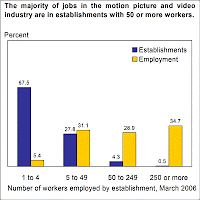
anywhere in the U.S. For example, in 2006, there were 357,000 wage and salary jobs in the film and video industries - mostly produciton jobs such as casting, acting, directing, editing, motion picture and videotape reproduction and film processing. Ten percent of those in the film industry were self-employed. They sell services to anyone who needs them, working for multiple productions throughout a year. Here's a chart that details the jobs.
Oh and in case you've wondered -- what is the most expensive city in the world? This year, Moscow is the the world's most expensive city for the second year in a row. London is in second place, climbing up three spots since the year 2006, while Seoul moves down a place in the ranks, taking third place. Tokyo is number four, while Asuncion in Paraguay remains the least expensive city, according to the source: Mercer Human Resource Consulting. New York was the base city, scoring 100 points, Moscow scores 134.4, London 126.3 and Seoul 122.4.
It may be easier for film professionals in Los Angeles, because everyone knows it's the hub of Hollywood, and that people can get to work on bigger film projects. But people have to pay more in living expenses for larger metropolitan cities.
What's more, the many ancillary industries are also affected in many ways when a big film hits the box office. For example, the DVD rentals and sales of the "Batman Begins" film, were boosted by the latest movie "The Dark Knight's." It claimed a record-breaking non-holiday weekend box office revenues of $158.4M, according to Rentrak's Box Office Essentials. That was a 345 percent increase in estimated DVD units sold from the prior week! This may have been because of the limited edition DVD gift set that was released on July 8, 2008 and coincided with the July 18th release of "The Dark Knight."
It's not any surprise that the U.S. motion picture industry produces most of the world’s feature films as well as most of the recorded TV shows. Dominated by six large studios based in Hollywood, over the years, things have started to change. With the increasing popularity and global availability of the Internet, cable television, digital video recorders, editing software and computer graphics there are more and more small to medium-sized independent filmmaking companies filling a growing demand, and they are located here and there across the country.

So if you want to learn how to be a film director, or go to a
film school in Los Angeles, odds are that you can get a job almost
anywhere in the U.S. For example, in 2006, there were 357,000 wage and salary jobs in the film and video industries - mostly produciton jobs such as casting, acting, directing, editing, motion picture and videotape reproduction and film processing. Ten percent of those in the film industry were self-employed. They sell services to anyone who needs them, working for multiple productions throughout a year. Here's a chart that details the jobs.
Oh and in case you've wondered -- what is the most expensive city in the world? This year, Moscow is the the world's most expensive city for the second year in a row. London is in second place, climbing up three spots since the year 2006, while Seoul moves down a place in the ranks, taking third place. Tokyo is number four, while Asuncion in Paraguay remains the least expensive city, according to the source: Mercer Human Resource Consulting. New York was the base city, scoring 100 points, Moscow scores 134.4, London 126.3 and Seoul 122.4.
Thursday, July 17, 2008
Uber.com for Entertainment Careers
Sometimes it's the right thing to do to pass along interesting information. If you have not checked out a website known as http://www.uber.com/, which is for artists, writers and musicians, then you may want to, or at least read Dennis Nishi's article in his How I Got Here column in the Wall Street Journal. (A hat tip to Dennis.) Uber is a social networking site that has grown to over 500,000 unique visits monthly, according to Nielson Online.
Maybe you are taking courses at the Entertainment Career Connection's Recording Connection school, and you are looking for information about the music industry, or you are an aspiring director who might even be looking for a career in the entertainment industry, Uber is a great website to check out.
In the Journal article he said, "Adjust to the market as opposed to the other way around... Emphasize your unique abilities so you can bring something different to projects. Have a good idea and a willingness to execute it. For me it's always been about creating personal networks. What I've learned in the new media realm and the art world is to keep things ad hoc and on the fly."

Maybe you are taking courses at the Entertainment Career Connection's Recording Connection school, and you are looking for information about the music industry, or you are an aspiring director who might even be looking for a career in the entertainment industry, Uber is a great website to check out.
Nishi interviewed the website's Founder Glenn Kaino, an artist and technologist, about competing in the social-networking space. Apparently Kaino initially wanted to work with artists that didn't have any access to the Web so he and his team contacted thousands of artists including Masami Teraoka and Edgar Heap of Birds and put up Web sites for them in order to document their projects.
Universities began linking to the site since it was not only cool, but a reference for original material. This is the genesis for Kaino's suggestions for other artists today.
In the Journal article he said, "Adjust to the market as opposed to the other way around... Emphasize your unique abilities so you can bring something different to projects. Have a good idea and a willingness to execute it. For me it's always been about creating personal networks. What I've learned in the new media realm and the art world is to keep things ad hoc and on the fly."
Today Uber is a compilation of everything from comedy blogs, and even a contingent of video gamers. The company's goal is "to be a publisher of world ideas online ... to facilitate an audience by allowing people to use our tools to express themselves."

There's a cool piece about Robert Price’s new gallery of tattoo work, (LEFT) including dogs, and Yoda.
Or, from Uber's music blogs, there's Dana's gallery of Motley Crue images from the Uber Crue Fest Photo Contest.
Thursday, July 10, 2008
How Students can Qualify for Sallie Mae Loans

We offer certificate programs in all aspects of filmmaking, radio broadcasting and audio engineering, but the really good news is that our Sallie Mae financial aid package more students have been able to get a start toward their career dreams with the Recording Connection, Radio Connection, and the Film Connection. Sallie Mae is the nation's leading provider of student loans. It is a free service, that comes with a Sallie Mae specialist who prepares student applications, which makes it ten times more likely for students to qualify for their loan.
What is covered by Sallie Mae student loans is the entire tuition costs and up to 60 percent in additional funds for living expenses and equipment purchases. Students who are 18 years of age or older with good credit may qualify for a zero down, low interest loan, starting at Prime Rate + 0%. Students can take up to 15 years to pay back the loan.
Entertainment Career Connection also provides other funding choices for those who don't qualify for Sallie Mae. Not only will Sallie Mae cover the entire tuition cost of $7450, but also loan up to 60% additional, or $4470, for living expenses and purchases.
CEO James Petulla said, “We started the new Sallie Mae student loan program in April of this year, and the program has financed about 84 students since then.”
More than 6,000 students have graduated from Entertainment Career Connection programs over the last 25 years, creating a vast alumni network. The company provides educational apprentice programs for the entertainment arts including the film, radio, television and music recording industries.
This is a fully accredited academic institution, and the Entertainment Career Connection programs are certified by the National Private Schools Accreditation Alliance with mentor programs in more than 100 U.S. cities in all fifty states. With corporate headquarters in Los Angeles, California and New York City, the Entertainment Career Connection schools are unlike any others, as students learn from successful mentors in real world situations in real studio and film sets.
Recently, nearly two dozen student loan lenders nationally have announced they are restricting, suspending or terminating new loans to students through the Federal Family Education Loan Program, or FFEL, the federally-guaranteed, low-cost initiative that provided college financing last year to 7 million students around the country.
Wednesday, June 11, 2008
Are You Mad as Hell? The Epitome of Survival Guides
 We couldn't help but notice this new website known as http://www.endoftheworldsurvivalguide.com/ or
The End of the World as we Know it... This could be really fun, and talk about the ultimate Entertainment Career Connection! The website is seeking bloggers and writers who are "mad as hell" and want to contribute to the site about the following topics:
- The War on the Middle Class
- Civil Liberties Abuses
- The Patriot Act
- The U.S. Constitution
- American Inperialis Meconomic Amageddon
- The Patriot Act
- Financial Collapse
- Debt
- The Failing Economy
- The two Way Party System
- Democrat and Republican Corruption
- Martial Lawgun Right
- Bib Brother
- The Police State
- Surveillance
- Media Propoganda
- Media Consolidation
- Mergers
- Border Atrocities
- False Flag Terrorism
- State sponsored Terrorism
- 9/11 Conspiracy Aleternatives
- Alternative Investments (GOLD, SILVER, MINING STOCKS)
If you are "Mad as Hell" and can commit to writing at least one article per every 10 days then email us at: mailto:thelastsurvivor@endoftheworldsurvivalguide.com and tell us how you see your very own blog here on our site, how often you would post and what your general topic of discussion would be.
If you don't want to make a long term commitment to writing a blog for us, you can still get active and stay involved by posting mentions of any and all rallies, protests, talks and lectures, book readings, book releases, shows to watch, movies to see, letters to write, petitions to sign, and alerts to government abuses on our message board.
Check it out.
Wednesday, May 21, 2008
Entertainment Industry Dreams Do Come True - As Proven by David Cook and American Idol
All the excitement this week and tonight at the finale of this season's American Idol, only proves that dreams can come true in the entertainment world. For the two David's -- Archuleta and Cook -- dreams are coming true, and after12 million votes, even though David Cook won, both Davids won because their lives will never be the same. One thing they got on the show was allot of mentoring.
Those of us at Entertainment Career Connection know how this works because every day we see students all over America who have a dream - to be the next famous film director, or to learn how to be a music DJ, or the next hottest sports announcer on the radio - and their dreams have come true too. And it's all because of mentors.
If you dream of being a music producer or have a band and want to make the best demo record possible, you could apprentice under the direct supervision of a music industry professional in a real recording studio working on real-world projects. There's no better way to learn.
Brian Levi is one of our mentors. He talks about how he recorded Dwight Yoakam's first album on the Los Angeles music recording school website.
According to one student, “There is no doubt about it, the Recording Connection mentor/apprentice program really works. I am working in the business and making my living in the music business because of the Recording Connection,” said Billy Flores, sound engineer for Eminem, the Rolling Stones, and Aretha Franklin.
Recording Connection students are actually doing things, not reading a book, sitting in a classroom; they’re involved in all aspects of the studio. And they don’t just learn to record, they learn the studio business too. It's a fully accredited institution certified by the National Private Schools Accreditation Alliance (NPSAA.) There are mentor programs in more than 100 U.S. cities in all fifty states for the radio, music recording, film and television industries.
Student loans are available via Sallie Mae, the nation's leading provider of student loans, and other financial aid programs. Plus the courses are not as expensive as some of the other schools. Whereas traditional film schools cost from $20,000 to $140,000, Entertainment Career Connection schools cost from $4,450 to $7,450. But the best part is that more than 72 percent of the students actually get an industry job after they complete their course. And isn't that the real reason to go to school and learn how to be a film producer, music DJ or whatever your entertainment dream may be in the first place?
Those of us at Entertainment Career Connection know how this works because every day we see students all over America who have a dream - to be the next famous film director, or to learn how to be a music DJ, or the next hottest sports announcer on the radio - and their dreams have come true too. And it's all because of mentors.
If you dream of being a music producer or have a band and want to make the best demo record possible, you could apprentice under the direct supervision of a music industry professional in a real recording studio working on real-world projects. There's no better way to learn.
Brian Levi is one of our mentors. He talks about how he recorded Dwight Yoakam's first album on the Los Angeles music recording school website.
According to one student, “There is no doubt about it, the Recording Connection mentor/apprentice program really works. I am working in the business and making my living in the music business because of the Recording Connection,” said Billy Flores, sound engineer for Eminem, the Rolling Stones, and Aretha Franklin.
Recording Connection students are actually doing things, not reading a book, sitting in a classroom; they’re involved in all aspects of the studio. And they don’t just learn to record, they learn the studio business too. It's a fully accredited institution certified by the National Private Schools Accreditation Alliance (NPSAA.) There are mentor programs in more than 100 U.S. cities in all fifty states for the radio, music recording, film and television industries.
Student loans are available via Sallie Mae, the nation's leading provider of student loans, and other financial aid programs. Plus the courses are not as expensive as some of the other schools. Whereas traditional film schools cost from $20,000 to $140,000, Entertainment Career Connection schools cost from $4,450 to $7,450. But the best part is that more than 72 percent of the students actually get an industry job after they complete their course. And isn't that the real reason to go to school and learn how to be a film producer, music DJ or whatever your entertainment dream may be in the first place?
Subscribe to:
Posts (Atom)


