Historically, during bad economic times, it is the entertainment industries that flourish - presumably, because people want to forget about their financial woes and drown themselves in happy distracting entertainment. Going to the movies is a good way out. And today, films are more accessible and available via NetFlix, video stores, and now online, meaning it doesn't break the bank no matter what age you are, or how bad off things are financially.
Here is another interesting tidbit. Fifteen years ago, the Sundance Film Festival got 500 submissions. This year, they received 5,000. Virtually all of these are privately financed films. Yet Mark Gill, who recently addressed an audience of film making professionals at the Los Angeles Film Festival, sited that Disney has gone from releasing 47 films in a year not too long ago to putting out only 12 films this year. Many of the “independent” branches of the studios have either been shrunk or dissolved altogether.
Gill also said, “If you want to survive in this brutal climate, you’re going to have to work a lot harder, be a lot smarter, know a lot more, move a lot faster, sell a lot better, pay attention to the data, be a little nicer, trust your gut, read everything and never, never give up.”
Yes, the competition is tough, and economics are making things challenging, but it is also a time where creative people can learn and seize their full potential, both now and later on.
That said, one also might wonder how this economy has effected the film school business, or those interested in programs at recording schools or radio schools for that matter. Because their mentorship programs are so reasonably priced, the Entertainment Career Connection's alternative film schools are really valuable, because people actually get jobs after they complete the programs - 74 percent to be exact. And, there has been a big increase in those taking the company's courses since January 2008. Student registrations in film, radio and recording are running about 160 percent over January 2008 -meaning the increase in the number of people who want to learn how to be a film director, or sign up for an audio engineer program or even those who want to learn to be a sports announcer, has been substantial.
Showing posts with label Los Angeles film school. Show all posts
Showing posts with label Los Angeles film school. Show all posts
Monday, October 13, 2008


Wednesday, September 24, 2008
Trends in Film Education: Malaysian Film Industry Poised to Grow
 Finas Director-General Mohd Mahyidin Mustakim said, "At a time when Malaysian cinema stands poised to influence the global film arena, filmmakers need to embrace the importance of marketing their movies," said recently at a meeting held at the National Film Development Corporation (Finas) in Ulu Kelang, Selangor.
It was a meeting that focused on the benefits of sales, marketing strategies, local film/TV show acquisitions for the international film markets. It appears as if they have realized that if Malaysian filmmakers have the right formula to market their films abroad, there’s a lot of money to be made. Many local filmmakers want to make money via films for the overseas market But up until now there has been a gap between how films are marketed locally and how they are marketed abroad.
Now there is a growing interest in film distribution abroad, and that means it is critical that they get exposure to marketing practices that will help these films cross over. It would seem that many could learn by taking some of the courses offered by schools like the Entertainment Career connection: http://www.film-connection.com/, for example, or Los Angeles music recording schools and even New York Radio schools, where mentors help students learn the real trade in a real classroom. Anyone interested in a career in film would benefit.
For those taking part in international film markets, it will make penetrating the international arena easier. Just as an example, with the cooperation of Finas, Malaysian producers have been part in three major international film markets including Hong Kong FilmArt in Wanchai, Hong Kong; and MIPTV and MIPCOM, in Cannes, France.
The statistics on transactions made by local producers at previous international film markets was RM1.57million, not as much as those in Hollywood or even Bollywood, but the important thing is that Malaysian film products are slowly getting the recognition. Many documentaries, animated series and TV shows are the hot-sellers among TV producers from Europe and the Middle East.
Foreign film producers typically like action-packed movies and thrillers.and due to the economy they have been cutting costs and not as active in acquiring programs from other countries. However, much is to be learned including trends, technology to the market ecology.
Finas will be taking part in the American Film Market (AFM) at Santa Monica in United States from on November 5 through 12.
Monday, July 28, 2008
Rock 'n' Roll Fantasy
In case you haven't heard, the House of Blues has been sponsoring a very cool nationwide promotion called the "Rock 'n' Roll Fantasy Camp" -- as featured in this BusinessWeek video clip that talks about how the camp lets people live their fantasy of being a rock star -- while still keeping their day job. No matter what age.
 By the way, Guns N' Roses has released five studio albums, two EPs, one live album, and three music video DVDs and the band is currently working on the infamous album Chinese Democracy. They have sold an estimated 90 million albums worldwide, including 39 million in the US.
Picture this ... lights are low, the crowd is screaming and the shaking. The opening act is about to take the stage…and the opening act is you! Many of us have dreamt about it and now it is a reality. Rock ‘n' Roll Fantasy Camp is a series of one-day camps that gives fans of all ages a chance to live their dream of being a Rock star. Rock ‘n’ Roll Fantasy, which has been critically acclaimed as the “Most Amazing Rock ‘n’ Roll Lifestyle Experience” by The London Times and “Brilliant” by Good Morning America, gives happy campers a once in a lifetime chance to meet, greet and also jam with legendary rock stars. Then they get to perform live on stage at major concert venue at the House of Blues and The Fillmore as the opening act for Extreme & King’s X,. it doesn't get much better...
Counselors for the 2008 summer schedule include Gilby Clark (Guns N’ Roses), Elliot Easton (The Cars), Earl Slick (David Bowie/John Lennon), Dave Ellefson (former Megadeth bassist), Glenn Hughes (Deep Purple), Chris Slade (AC/DC, The Firm with Jimmy Page), Mark Slaughter (Slaughter), Mark Hudson (Aerosmith, Grammy Award winning writer/producer), Kip Winger (Winger) and many more to be announced.
As mentioned in Los Angeles Magazine's August issue, at the Los Angeles House of Blues, this August 26th, 2008 venue will feature Guns N' Roses guitarist Gilby Clarke as a faculty member. History knows this controversial American hard rock band was formed in LA in 1985. Camp costs between $1,999 and 9,999. You can call 888-762-2263 if you want to sign up. or go to http://www.rocknrollfantasycamp.
 By the way, Guns N' Roses has released five studio albums, two EPs, one live album, and three music video DVDs and the band is currently working on the infamous album Chinese Democracy. They have sold an estimated 90 million albums worldwide, including 39 million in the US.
Tremendously successful at every city nationwide where the venue takes place, this is just proof that programs like the Entertainment Career Connection's Recording Connection mentor programs work. Anyone looking to learn to be a recording engineer, would probably love to attend this camp!
Picture this ... lights are low, the crowd is screaming and the shaking. The opening act is about to take the stage…and the opening act is you! Many of us have dreamt about it and now it is a reality. Rock ‘n' Roll Fantasy Camp is a series of one-day camps that gives fans of all ages a chance to live their dream of being a Rock star. Rock ‘n’ Roll Fantasy, which has been critically acclaimed as the “Most Amazing Rock ‘n’ Roll Lifestyle Experience” by The London Times and “Brilliant” by Good Morning America, gives happy campers a once in a lifetime chance to meet, greet and also jam with legendary rock stars. Then they get to perform live on stage at major concert venue at the House of Blues and The Fillmore as the opening act for Extreme & King’s X,. it doesn't get much better...
Counselors for the 2008 summer schedule include Gilby Clark (Guns N’ Roses), Elliot Easton (The Cars), Earl Slick (David Bowie/John Lennon), Dave Ellefson (former Megadeth bassist), Glenn Hughes (Deep Purple), Chris Slade (AC/DC, The Firm with Jimmy Page), Mark Slaughter (Slaughter), Mark Hudson (Aerosmith, Grammy Award winning writer/producer), Kip Winger (Winger) and many more to be announced.
Thursday, July 24, 2008
Where is the best place to go to film school?
Most film schools have one campus, a few have multiple campuses, and then apprentice schools like the entertainment industry's best kept secret - the film-connection - has schools that are located pretty much anywhere. There are pros and cons about working in the film industry in big cities like Los Angeles or New York.
It may be easier for film professionals in Los Angeles, because everyone knows it's the hub of Hollywood, and that people can get to work on bigger film projects. But people have to pay more in living expenses for larger metropolitan cities.
What's more, the many ancillary industries are also affected in many ways when a big film hits the box office. For example, the DVD rentals and sales of the "Batman Begins" film, were boosted by the latest movie "The Dark Knight's." It claimed a record-breaking non-holiday weekend box office revenues of $158.4M, according to Rentrak's Box Office Essentials. That was a 345 percent increase in estimated DVD units sold from the prior week! This may have been because of the limited edition DVD gift set that was released on July 8, 2008 and coincided with the July 18th release of "The Dark Knight."
It's not any surprise that the U.S. motion picture industry produces most of the world’s feature films as well as most of the recorded TV shows. Dominated by six large studios based in Hollywood, over the years, things have started to change. With the increasing popularity and global availability of the Internet, cable television, digital video recorders, editing software and computer graphics there are more and more small to medium-sized independent filmmaking companies filling a growing demand, and they are located here and there across the country.
So if you want to learn how to be a film director, or go to a
film school in Los Angeles, odds are that you can get a job almost
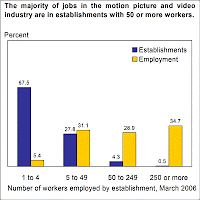
anywhere in the U.S. For example, in 2006, there were 357,000 wage and salary jobs in the film and video industries - mostly produciton jobs such as casting, acting, directing, editing, motion picture and videotape reproduction and film processing. Ten percent of those in the film industry were self-employed. They sell services to anyone who needs them, working for multiple productions throughout a year. Here's a chart that details the jobs.
Oh and in case you've wondered -- what is the most expensive city in the world? This year, Moscow is the the world's most expensive city for the second year in a row. London is in second place, climbing up three spots since the year 2006, while Seoul moves down a place in the ranks, taking third place. Tokyo is number four, while Asuncion in Paraguay remains the least expensive city, according to the source: Mercer Human Resource Consulting. New York was the base city, scoring 100 points, Moscow scores 134.4, London 126.3 and Seoul 122.4.
It may be easier for film professionals in Los Angeles, because everyone knows it's the hub of Hollywood, and that people can get to work on bigger film projects. But people have to pay more in living expenses for larger metropolitan cities.
What's more, the many ancillary industries are also affected in many ways when a big film hits the box office. For example, the DVD rentals and sales of the "Batman Begins" film, were boosted by the latest movie "The Dark Knight's." It claimed a record-breaking non-holiday weekend box office revenues of $158.4M, according to Rentrak's Box Office Essentials. That was a 345 percent increase in estimated DVD units sold from the prior week! This may have been because of the limited edition DVD gift set that was released on July 8, 2008 and coincided with the July 18th release of "The Dark Knight."
It's not any surprise that the U.S. motion picture industry produces most of the world’s feature films as well as most of the recorded TV shows. Dominated by six large studios based in Hollywood, over the years, things have started to change. With the increasing popularity and global availability of the Internet, cable television, digital video recorders, editing software and computer graphics there are more and more small to medium-sized independent filmmaking companies filling a growing demand, and they are located here and there across the country.

So if you want to learn how to be a film director, or go to a
film school in Los Angeles, odds are that you can get a job almost
anywhere in the U.S. For example, in 2006, there were 357,000 wage and salary jobs in the film and video industries - mostly produciton jobs such as casting, acting, directing, editing, motion picture and videotape reproduction and film processing. Ten percent of those in the film industry were self-employed. They sell services to anyone who needs them, working for multiple productions throughout a year. Here's a chart that details the jobs.
Oh and in case you've wondered -- what is the most expensive city in the world? This year, Moscow is the the world's most expensive city for the second year in a row. London is in second place, climbing up three spots since the year 2006, while Seoul moves down a place in the ranks, taking third place. Tokyo is number four, while Asuncion in Paraguay remains the least expensive city, according to the source: Mercer Human Resource Consulting. New York was the base city, scoring 100 points, Moscow scores 134.4, London 126.3 and Seoul 122.4.
Thursday, July 17, 2008
Uber.com for Entertainment Careers
Sometimes it's the right thing to do to pass along interesting information. If you have not checked out a website known as http://www.uber.com/, which is for artists, writers and musicians, then you may want to, or at least read Dennis Nishi's article in his How I Got Here column in the Wall Street Journal. (A hat tip to Dennis.) Uber is a social networking site that has grown to over 500,000 unique visits monthly, according to Nielson Online.
Maybe you are taking courses at the Entertainment Career Connection's Recording Connection school, and you are looking for information about the music industry, or you are an aspiring director who might even be looking for a career in the entertainment industry, Uber is a great website to check out.
In the Journal article he said, "Adjust to the market as opposed to the other way around... Emphasize your unique abilities so you can bring something different to projects. Have a good idea and a willingness to execute it. For me it's always been about creating personal networks. What I've learned in the new media realm and the art world is to keep things ad hoc and on the fly."

Maybe you are taking courses at the Entertainment Career Connection's Recording Connection school, and you are looking for information about the music industry, or you are an aspiring director who might even be looking for a career in the entertainment industry, Uber is a great website to check out.
Nishi interviewed the website's Founder Glenn Kaino, an artist and technologist, about competing in the social-networking space. Apparently Kaino initially wanted to work with artists that didn't have any access to the Web so he and his team contacted thousands of artists including Masami Teraoka and Edgar Heap of Birds and put up Web sites for them in order to document their projects.
Universities began linking to the site since it was not only cool, but a reference for original material. This is the genesis for Kaino's suggestions for other artists today.
In the Journal article he said, "Adjust to the market as opposed to the other way around... Emphasize your unique abilities so you can bring something different to projects. Have a good idea and a willingness to execute it. For me it's always been about creating personal networks. What I've learned in the new media realm and the art world is to keep things ad hoc and on the fly."
Today Uber is a compilation of everything from comedy blogs, and even a contingent of video gamers. The company's goal is "to be a publisher of world ideas online ... to facilitate an audience by allowing people to use our tools to express themselves."

There's a cool piece about Robert Price’s new gallery of tattoo work, (LEFT) including dogs, and Yoda.
Or, from Uber's music blogs, there's Dana's gallery of Motley Crue images from the Uber Crue Fest Photo Contest.
Thursday, July 10, 2008
How Students can Qualify for Sallie Mae Loans

We offer certificate programs in all aspects of filmmaking, radio broadcasting and audio engineering, but the really good news is that our Sallie Mae financial aid package more students have been able to get a start toward their career dreams with the Recording Connection, Radio Connection, and the Film Connection. Sallie Mae is the nation's leading provider of student loans. It is a free service, that comes with a Sallie Mae specialist who prepares student applications, which makes it ten times more likely for students to qualify for their loan.
What is covered by Sallie Mae student loans is the entire tuition costs and up to 60 percent in additional funds for living expenses and equipment purchases. Students who are 18 years of age or older with good credit may qualify for a zero down, low interest loan, starting at Prime Rate + 0%. Students can take up to 15 years to pay back the loan.
Entertainment Career Connection also provides other funding choices for those who don't qualify for Sallie Mae. Not only will Sallie Mae cover the entire tuition cost of $7450, but also loan up to 60% additional, or $4470, for living expenses and purchases.
CEO James Petulla said, “We started the new Sallie Mae student loan program in April of this year, and the program has financed about 84 students since then.”
More than 6,000 students have graduated from Entertainment Career Connection programs over the last 25 years, creating a vast alumni network. The company provides educational apprentice programs for the entertainment arts including the film, radio, television and music recording industries.
This is a fully accredited academic institution, and the Entertainment Career Connection programs are certified by the National Private Schools Accreditation Alliance with mentor programs in more than 100 U.S. cities in all fifty states. With corporate headquarters in Los Angeles, California and New York City, the Entertainment Career Connection schools are unlike any others, as students learn from successful mentors in real world situations in real studio and film sets.
Recently, nearly two dozen student loan lenders nationally have announced they are restricting, suspending or terminating new loans to students through the Federal Family Education Loan Program, or FFEL, the federally-guaranteed, low-cost initiative that provided college financing last year to 7 million students around the country.
Monday, June 30, 2008
SAG Negotiations for People with Film Careers
The Screen Actors Guild (SAG) is deep into negotiations with the entertainment industry's film and television producers over a new contract, making it's membership's middle-income actors the focus for better contract terms - especially given today's economy. The Guild is seeking increases for items such as reimbursement rates for car mileage to residual payments, and more.
SAG has about 122,000 actor members, and the contract expires at midnight on Monday 6/30. Much like the recent writer's strike the Hollywood community has been on edge about a SAG strike, which in reality cannot take place until around Aug. 1st. The Guild leaders haven't called for a strike authorization vote yet. This is when 75 percent of the entire membership must vote for the strike in order for it to happen.
Most film schools, including the Entertainment Career Connection's courses on how to become a director cover the guilds like SAG. The Film/Television/Video production course curriculum qualifies graduates for positions in the film, television and video production fields. This experience is invaluable when it comes to learning about strikes, and the rights of guild members

In this June 25, 2008 photo, SAG President Alan Rosenberg says the union remains committed to negotiating a new deal with Hollywood producers as the contract expiration looms. (AP Photo/Gus Ruelas, File)
At the Film Connection, industry experts who are already producers or directors pass their knowledge and experience on to the students that they mentor. The Film Connection, a fully accredited academic institution certified by the National Private Schools Accreditation Alliance, provides educational apprentice programs for the film, radio, television and the music recording industries in more than 100 U.S. cities in all 50 states. The program provides training the practical way under real life working conditions - so if a strike is going to happen, then the students learn how it will affect them so they too can make decisions once they are out in the real world.
Wednesday, June 25, 2008
Myths About Mentoring and Careers in Entertainment

The Entertainment Career Connection has about 25 years of experience in the topic of “mentoring.” And we get a lot of questions about how our mentors do their jobs. There are many thoughts on the topic. Webster’s dictionary defines a mentor as:
Main Entry:
1men·tor
Pronunciation:
\ˈmen-ˌtȯr, -tər\
Function:
noun
Etymology:
Latin, from Greek Mentōr
Date:
1616
1capitalized : a friend of Odysseus entrusted with the education of Odysseus' son Telemachus2 a: a trusted counselor or guide b: tutor, coach — men·tor·ship \-ˌship\ noun
1men·tor
Pronunciation:
\ˈmen-ˌtȯr, -tər\
Function:
noun
Etymology:
Latin, from Greek Mentōr
Date:
1616
1capitalized : a friend of Odysseus entrusted with the education of Odysseus' son Telemachus2 a: a trusted counselor or guide b: tutor, coach — men·tor·ship \-ˌship\ noun
Here are ten myths and some of our observations about today’s contemporary trends in mentoring. Wether you want to learn to be a film producer, or need to learn how to be a recording artist, or arte interested in a career in radio, learning from an entertainment Connection mentor is the way to really learn.
1) You do not need to be a Yogi to be a mentor. It is possibly the most frequent method of sharing knowledge in our global society, and anyone with the experience to be a powerful learning influence can be a mentor today.
2) Effective mentoring means that both parties perceive benefits. The best mentors are not necessarily people who set out to be mentors. One-on-one, face-to-face mentoring is now easier today thanks to modern technology - it can can even be via telephone, fax or email.
3) Mentoring requires commitment of time that few professionals can afford. NOT TRUE> Mentoring is simply helping someone learn while you are on the job. The reality is that it can increase on-the-job performance for the mentor along with learning, and gives career opportunities for the person being trained.
4) If someone is mentoring a student, there is no loss of productivity because mentoring actually improves productivity -- through better communication, clarity of goals, commitment, and planning, not to mention attention to the student.
5) Age is not a factor for mentors, because technology, innovation, and other learned skills (such as the Internet marketing) happen so fast today that sometimes mentors end up being the young mentoring older folks.
6) Young people who have bad attitudes can't learn by a mentor. NOT TRUE. Most young people often view an older mentor guide with respect, so they listen to them and learn.
7) Today’s changing economy and globalization means that learning increases job stability during crisis and change management.
8) When provided with a vision and purpose combined with skill training and support, adults were more likely to volunteer as a mentor.
3) Mentoring requires commitment of time that few professionals can afford. NOT TRUE> Mentoring is simply helping someone learn while you are on the job. The reality is that it can increase on-the-job performance for the mentor along with learning, and gives career opportunities for the person being trained.
4) If someone is mentoring a student, there is no loss of productivity because mentoring actually improves productivity -- through better communication, clarity of goals, commitment, and planning, not to mention attention to the student.
5) Age is not a factor for mentors, because technology, innovation, and other learned skills (such as the Internet marketing) happen so fast today that sometimes mentors end up being the young mentoring older folks.
6) Young people who have bad attitudes can't learn by a mentor. NOT TRUE. Most young people often view an older mentor guide with respect, so they listen to them and learn.
7) Today’s changing economy and globalization means that learning increases job stability during crisis and change management.
8) When provided with a vision and purpose combined with skill training and support, adults were more likely to volunteer as a mentor.
9) Students do not learn as much in a classroom - they learn more while experiencing the job.
10) Mentoring is becomming the most economical, productive and successful form of teaching today.
At the Entertainment Career Connection mentors share their experiences. The Film Connection's Film School takes you out of the classroom and onto real film sets where you'll learn by doing stuff while you learn, one-on-one with your mentor, who is a working professional in the area of film you want to study. No other film school comes close to succeeding like this.
Listen to how to break into the entertainment business.
Monday, June 16, 2008
The Truth about Learning How to Be a Film Director
Directing films is a job that despite some stories about lucky people, requires an education. Yes, Quentin Tarantino dropped out of high school and never went to film school. But that is rare.
There are many college programs available that offer access to the latest lights, cameras, and film making technology -- but the truth is, the best education for a film career is on the job training. Education requirements for learning the techniques means you can get certification for the technical aspects of film making. The work as a director can be challenging, yet flexible and very rewarding. Courses of study often focus on the elements of a successful film plot, characters, and style.
Directors need to know every aspect of a film's production, from editing to cinematography to digital and sound effects. Many of you probably already have inexpensive modern digital cameras and editing software at home. This just means that film making and directing has never been more accessible to the average person, so there is lots of competition out there. Very few first time directors get to work on million dollar budget summer blockbusters. Directors usually have to work their way up, sometimes by directing commercials or music videos. And salaries for film and movie directors are unpredictable at best.
There are plenty of websites including our own, that can help serious filmmakers, such as imbd.com, dv.com, or indietalk.com. There are forums where independent movie makers gather to discuss tips and tricks. Like our own at the Film Connection, which hosts videos of our mentor teachers helping anyone who wants to learn how to be a film director. The Film Connection Directing School is accredited and will prepare you for all the steps to make your own feature film, music video or commercial. You get to work under the direct supervision of a professional director in the film industry. Usually within six months, you'll have all the experience, knowledge and connections you need to direct your first feature. The Entertainment Film Connection (http://www.film-connection.com/) will find a mentor professional --a film, commercial or music video director -- that's about 90 minutes or less from where you live.
If you get accepted into our film program, this professional filmmaker will become your personal tutor, or a private mentor, and will teach you just about all you need to know get into the film business, In addition to that, your mentor will introduce you to his or her connections in the film business. You will get to work on real movie, TV, commercial or music video projects.
This method is proven to work, and it sure beats sitting in some overcrowded, overpriced college classroom. Check out what our students and mentors are saying about a career in film directing on YouTube.
There are many college programs available that offer access to the latest lights, cameras, and film making technology -- but the truth is, the best education for a film career is on the job training. Education requirements for learning the techniques means you can get certification for the technical aspects of film making. The work as a director can be challenging, yet flexible and very rewarding. Courses of study often focus on the elements of a successful film plot, characters, and style.
Directors need to know every aspect of a film's production, from editing to cinematography to digital and sound effects. Many of you probably already have inexpensive modern digital cameras and editing software at home. This just means that film making and directing has never been more accessible to the average person, so there is lots of competition out there. Very few first time directors get to work on million dollar budget summer blockbusters. Directors usually have to work their way up, sometimes by directing commercials or music videos. And salaries for film and movie directors are unpredictable at best.
There are plenty of websites including our own, that can help serious filmmakers, such as imbd.com, dv.com, or indietalk.com. There are forums where independent movie makers gather to discuss tips and tricks. Like our own at the Film Connection, which hosts videos of our mentor teachers helping anyone who wants to learn how to be a film director. The Film Connection Directing School is accredited and will prepare you for all the steps to make your own feature film, music video or commercial. You get to work under the direct supervision of a professional director in the film industry. Usually within six months, you'll have all the experience, knowledge and connections you need to direct your first feature. The Entertainment Film Connection (http://www.film-connection.com/) will find a mentor professional --a film, commercial or music video director -- that's about 90 minutes or less from where you live.
If you get accepted into our film program, this professional filmmaker will become your personal tutor, or a private mentor, and will teach you just about all you need to know get into the film business, In addition to that, your mentor will introduce you to his or her connections in the film business. You will get to work on real movie, TV, commercial or music video projects.
This method is proven to work, and it sure beats sitting in some overcrowded, overpriced college classroom. Check out what our students and mentors are saying about a career in film directing on YouTube.
Wednesday, June 11, 2008
Are You Mad as Hell? The Epitome of Survival Guides
 We couldn't help but notice this new website known as http://www.endoftheworldsurvivalguide.com/ or
The End of the World as we Know it... This could be really fun, and talk about the ultimate Entertainment Career Connection! The website is seeking bloggers and writers who are "mad as hell" and want to contribute to the site about the following topics:
- The War on the Middle Class
- Civil Liberties Abuses
- The Patriot Act
- The U.S. Constitution
- American Inperialis Meconomic Amageddon
- The Patriot Act
- Financial Collapse
- Debt
- The Failing Economy
- The two Way Party System
- Democrat and Republican Corruption
- Martial Lawgun Right
- Bib Brother
- The Police State
- Surveillance
- Media Propoganda
- Media Consolidation
- Mergers
- Border Atrocities
- False Flag Terrorism
- State sponsored Terrorism
- 9/11 Conspiracy Aleternatives
- Alternative Investments (GOLD, SILVER, MINING STOCKS)
If you are "Mad as Hell" and can commit to writing at least one article per every 10 days then email us at: mailto:thelastsurvivor@endoftheworldsurvivalguide.com and tell us how you see your very own blog here on our site, how often you would post and what your general topic of discussion would be.
If you don't want to make a long term commitment to writing a blog for us, you can still get active and stay involved by posting mentions of any and all rallies, protests, talks and lectures, book readings, book releases, shows to watch, movies to see, letters to write, petitions to sign, and alerts to government abuses on our message board.
Check it out.
Thursday, May 29, 2008
Choices About Music Recording Careers
With the economic trends being more challenging over the last few months, you may be one of a bunch of students out there who are weighing your options when it comes to your next step after graduation. Is college an option? Or are there other ways to get into the music recording business? We (those of us at the Entertainment Career Connection) see this all the time.
In fact there are a number of students who actually went to college, then came to us after that to REALLY learn the business. At the Los Angeles music recording school, it only makes sense that we got our own students and mentor teachers on video to explain their stories. Check out Los Angeles recording school mentor Doug Maxwell's video on YouTube. He has some great tips and comments.
Another cool story from student Leslie Greer in Atlanta, “During my apprenticeship I got to meet P. Ditty, Master P. and Jermaine Dupri. I had the honor of working with David Banner in Atlanta. I can’t even explain to you how much this program did for me. I thank you and bless you.”
There is just tons of stuff that the Recording Connection programs teach that you just don't, or can't get in traditional schools. The curriculum qualifies graduates for positions as a music producer or a recording studio engineer. Plus the best thing is that students are taught in one-on-one private sessions in a real recording studio. It's an apprentice type situation - under the direct supervision of a music industry professional working on real-world projects. Plus there's no experience necessary, and students can take classes part time during night or weekend sessions, training around a current job.
The teachers are mentors who know how to succeed in the very competitive recording and engineering field - so they end up passing their knowledge and experience on to the students. It is a win-win situation.
In fact there are a number of students who actually went to college, then came to us after that to REALLY learn the business. At the Los Angeles music recording school, it only makes sense that we got our own students and mentor teachers on video to explain their stories. Check out Los Angeles recording school mentor Doug Maxwell's video on YouTube. He has some great tips and comments.
Another cool story from student Leslie Greer in Atlanta, “During my apprenticeship I got to meet P. Ditty, Master P. and Jermaine Dupri. I had the honor of working with David Banner in Atlanta. I can’t even explain to you how much this program did for me. I thank you and bless you.”
There is just tons of stuff that the Recording Connection programs teach that you just don't, or can't get in traditional schools. The curriculum qualifies graduates for positions as a music producer or a recording studio engineer. Plus the best thing is that students are taught in one-on-one private sessions in a real recording studio. It's an apprentice type situation - under the direct supervision of a music industry professional working on real-world projects. Plus there's no experience necessary, and students can take classes part time during night or weekend sessions, training around a current job.
The teachers are mentors who know how to succeed in the very competitive recording and engineering field - so they end up passing their knowledge and experience on to the students. It is a win-win situation.
Wednesday, May 21, 2008
Entertainment Industry Dreams Do Come True - As Proven by David Cook and American Idol
All the excitement this week and tonight at the finale of this season's American Idol, only proves that dreams can come true in the entertainment world. For the two David's -- Archuleta and Cook -- dreams are coming true, and after12 million votes, even though David Cook won, both Davids won because their lives will never be the same. One thing they got on the show was allot of mentoring.
Those of us at Entertainment Career Connection know how this works because every day we see students all over America who have a dream - to be the next famous film director, or to learn how to be a music DJ, or the next hottest sports announcer on the radio - and their dreams have come true too. And it's all because of mentors.
If you dream of being a music producer or have a band and want to make the best demo record possible, you could apprentice under the direct supervision of a music industry professional in a real recording studio working on real-world projects. There's no better way to learn.
Brian Levi is one of our mentors. He talks about how he recorded Dwight Yoakam's first album on the Los Angeles music recording school website.
According to one student, “There is no doubt about it, the Recording Connection mentor/apprentice program really works. I am working in the business and making my living in the music business because of the Recording Connection,” said Billy Flores, sound engineer for Eminem, the Rolling Stones, and Aretha Franklin.
Recording Connection students are actually doing things, not reading a book, sitting in a classroom; they’re involved in all aspects of the studio. And they don’t just learn to record, they learn the studio business too. It's a fully accredited institution certified by the National Private Schools Accreditation Alliance (NPSAA.) There are mentor programs in more than 100 U.S. cities in all fifty states for the radio, music recording, film and television industries.
Student loans are available via Sallie Mae, the nation's leading provider of student loans, and other financial aid programs. Plus the courses are not as expensive as some of the other schools. Whereas traditional film schools cost from $20,000 to $140,000, Entertainment Career Connection schools cost from $4,450 to $7,450. But the best part is that more than 72 percent of the students actually get an industry job after they complete their course. And isn't that the real reason to go to school and learn how to be a film producer, music DJ or whatever your entertainment dream may be in the first place?
Those of us at Entertainment Career Connection know how this works because every day we see students all over America who have a dream - to be the next famous film director, or to learn how to be a music DJ, or the next hottest sports announcer on the radio - and their dreams have come true too. And it's all because of mentors.
If you dream of being a music producer or have a band and want to make the best demo record possible, you could apprentice under the direct supervision of a music industry professional in a real recording studio working on real-world projects. There's no better way to learn.
Brian Levi is one of our mentors. He talks about how he recorded Dwight Yoakam's first album on the Los Angeles music recording school website.
According to one student, “There is no doubt about it, the Recording Connection mentor/apprentice program really works. I am working in the business and making my living in the music business because of the Recording Connection,” said Billy Flores, sound engineer for Eminem, the Rolling Stones, and Aretha Franklin.
Recording Connection students are actually doing things, not reading a book, sitting in a classroom; they’re involved in all aspects of the studio. And they don’t just learn to record, they learn the studio business too. It's a fully accredited institution certified by the National Private Schools Accreditation Alliance (NPSAA.) There are mentor programs in more than 100 U.S. cities in all fifty states for the radio, music recording, film and television industries.
Student loans are available via Sallie Mae, the nation's leading provider of student loans, and other financial aid programs. Plus the courses are not as expensive as some of the other schools. Whereas traditional film schools cost from $20,000 to $140,000, Entertainment Career Connection schools cost from $4,450 to $7,450. But the best part is that more than 72 percent of the students actually get an industry job after they complete their course. And isn't that the real reason to go to school and learn how to be a film producer, music DJ or whatever your entertainment dream may be in the first place?
Monday, May 19, 2008
Student Loans in the News
Have you noticed all the news about student loans - just when school is about to end for the summer, and kids are gonna need loans to go to college? But there was one interesting online news article today that pointed out -- as American Idol concludes its season this week, it appears that finalist David Archuleta won't be needing any student loans in the future. Archuleta has done enough in the competition vocally to ensure that when and if he decides to go to college, he will not need a student loan.
But many other strudents will. Those students who are looking for a film school, or those who want to learn how to be a DJ - even students who want to learn how to be a recording artist - all will be faced with challenges when it comes to student loans. But one Los Angeles film school, who also has schools for recording and the music industries, known as the Entertainment Career Connection, has recently gotten Sallie Mae loans for students, the nation's leading provider of student loan programs.
The Entertainment Connection's Sallie Mae loans covers the entire tuition cost and also loans for up to 60 percent of additional funds for living expenses and equipment purchases. Any student who is 18 years of age or older with good credit may qualify for a zero down, low interest loan. These start at Prime Rate + 0%, and take up to 15 years to pay back. Entertainment Career Connection also provides other funding choices for those who may not qualify for the Sallie Mae loan programs.
During the last 25 years the Entertainment Career Connection has graduated more than 6,000 students from its educational apprentice programs for the entertainment arts including the film, radio, television and music recording industries.
Chief Executive Officer James (Jimi) Petulla recently said, "As other national student loan programs are taking a beating, making it hard for students to secure low-cost loans for college, we are happy to introduce our new student loan programs so that students can sign up for our apprentice programs.”
But many other strudents will. Those students who are looking for a film school, or those who want to learn how to be a DJ - even students who want to learn how to be a recording artist - all will be faced with challenges when it comes to student loans. But one Los Angeles film school, who also has schools for recording and the music industries, known as the Entertainment Career Connection, has recently gotten Sallie Mae loans for students, the nation's leading provider of student loan programs.
The Entertainment Connection's Sallie Mae loans covers the entire tuition cost and also loans for up to 60 percent of additional funds for living expenses and equipment purchases.
 Any student who is 18 years of age or older with good credit may qualify for a zero down, low interest loan. These start at Prime Rate + 0%, and take up to 15 years to pay back. Entertainment Career Connection also provides other funding choices for those who may not qualify for the Sallie Mae loan programs.
During the last 25 years the Entertainment Career Connection has graduated more than 6,000 students from its educational apprentice programs for the entertainment arts including the film, radio, television and music recording industries.
Chief Executive Officer James (Jimi) Petulla recently said, "As other national student loan programs are taking a beating, making it hard for students to secure low-cost loans for college, we are happy to introduce our new student loan programs so that students can sign up for our apprentice programs.”
Tuesday, May 13, 2008
Los Angeles Film School Gets People Jobs
When you think about how much time college students spend getting an education, and the money involved as well, it is hard to imagine a school where you can learn just what you need, and get yourself a job at the same time. One Los Angeles film school known as the Entertainment Career Connection offers a production course curriculum that qualifies graduates for positions in the film, television, video and music video fields.
Here's how this works. You get industry experts who pass on their knowledge to the Film Connection classroom and provide an interactive and exciting atmosphere where they, as mentor teachers,work openly between sound stages, movie sets and the classroom. The school provides training on real sets and under real life working conditions. You get to be trained one-on-one by a working professional. The mentor proactively teaches both professional and technical skills, helping to bridge the gap between academia and the workplace. So when you are done, you will most likely get a job in the industry.
Here's what one student had to say. “With Film Connection you learn more do more and are better equipped to get a job in the film industry upon graduation. Those over-priced film schools just don’t work. You come out under-trained, unemployed and broke. The Film Connection concept is brilliant. It’s the alternative that really works,” said Mars Callahan, Writer, Director and Mentor, Pool House Junkies
You would be screened by the school, and then re-screened by the mentors. The Entertainment Connection’s programs can be completed in approximately half the time of degrees obtained from other schools. Plus, no experience is required and you can start any time. Most schools have specific semesters. Some of the Entertainment Connection students even take classes part time during night or weekend sessions, so this way they can train around their current job schedule. The average course length is five to seven months, depending upon the schedule.
In business for 25 years, the Entertainment Career Connection offers a number of paymetn plans towards totals $6,450 for payment in full. A one-year payment plan requires a down payment of $2,500 and 12 monthly payments of $465 per month totaling $8,080 and including finance charges of 12.5% per annum. Two year payment plan tuition is payable via a down payment of $2,500 and 12 monthly payments of $250 followed by another 12 monthly payments of $ 306, totaling $9,172 with finance charges at 21.5 percent per annum.
A fully accredited academic institution, the Film Connection is certified by the National Private Schools Accreditation Alliance with mentor programs in more than 100 U.S. cities in all fifty states. In fact, the Entertainment Career Connection is an associate member of the National Broadcasters Association (NAB), The American Federation of Radio and Television Artists (AFTRA), and the Society for Professional Audio Recording Services (SPARS).
Here's how this works. You get industry experts who pass on their knowledge to the Film Connection classroom and provide an interactive and exciting atmosphere where they, as mentor teachers,work openly between sound stages, movie sets and the classroom. The school provides training on real sets and under real life working conditions. You get to be trained one-on-one by a working professional. The mentor proactively teaches both professional and technical skills, helping to bridge the gap between academia and the workplace. So when you are done, you will most likely get a job in the industry.
Here's what one student had to say. “With Film Connection you learn more do more and are better equipped to get a job in the film industry upon graduation. Those over-priced film schools just don’t work. You come out under-trained, unemployed and broke. The Film Connection concept is brilliant. It’s the alternative that really works,” said Mars Callahan, Writer, Director and Mentor, Pool House Junkies
You would be screened by the school, and then re-screened by the mentors. The Entertainment Connection’s programs can be completed in approximately half the time of degrees obtained from other schools. Plus, no experience is required and you can start any time. Most schools have specific semesters. Some of the Entertainment Connection students even take classes part time during night or weekend sessions, so this way they can train around their current job schedule. The average course length is five to seven months, depending upon the schedule.
In business for 25 years, the Entertainment Career Connection offers a number of paymetn plans towards totals $6,450 for payment in full. A one-year payment plan requires a down payment of $2,500 and 12 monthly payments of $465 per month totaling $8,080 and including finance charges of 12.5% per annum. Two year payment plan tuition is payable via a down payment of $2,500 and 12 monthly payments of $250 followed by another 12 monthly payments of $ 306, totaling $9,172 with finance charges at 21.5 percent per annum.
A fully accredited academic institution, the Film Connection is certified by the National Private Schools Accreditation Alliance with mentor programs in more than 100 U.S. cities in all fifty states. In fact, the Entertainment Career Connection is an associate member of the National Broadcasters Association (NAB), The American Federation of Radio and Television Artists (AFTRA), and the Society for Professional Audio Recording Services (SPARS).
Friday, May 9, 2008
So you want to learn how to be a DJ
It may sound threatening, but if this is your life dream, it may not be as hard as you think. And sure you can study this in schools, but the reality is that real life situations and mentoring is so much better. There is a 13 part course that includes a written curriculum along with training guides. The hands-on lab drills are performed in an actual radio station in the student’s local area. So if you want to learn how to be a DJ, the right place just may be the Entertainment Career Connection mentor program.
Radio Connection graduate Howard Parker got his first job through the Entertainment Career Connection and today he makes millions of dollars. His job? He does movie trailer voice-overs.
Parker said, “During my course at Radio Connection in Philadelphia, I learned about everything in the radio business from news to on air production, commercial making, computers and even satellites. Real on-the-job experience allowed me to get a job in less than two weeks after graduation.”
The radio broadcast teachers are comprised of a real on-air personality or program director. Radio professionals are mentors who know how to succeed in the highly competitive broadcasting industry. These industry experts share knowledge and experience and provide training a really practical way, so students learn in a real station, under real life working conditions, being trained one-on-one by a working professional. The mentor faculty proactively teaches both professional and technical skills, which helps to bridge the gap between the workplace and academia.
Finding a good school is not only about which school will provide an education that the industry will take seriously, costs also play into the formula. Colleges and universities have formulas that they use, so applicants are charged by the credit hour, by clock hour, or by semester. With fees, books and supplies, it can add up. Entertainment Career Connection schools start as low as $4,450, so the training is affordable, especially when a job is just around the corner.
An associate member of the National Broadcasters Association (NAB), The American Federation of Radio and Television Artists (AFTRA), The Entertainment Career Connection is also a member of the Society for Professional Audio Recording Services (SPARS).
With more than 72 percent of its graduates are placed in jobs, the Entertainment Career Connection provides educational apprentice programs for the entertainment arts including the film and TV, and music recording industries. Over the last 24 years more than 6,000 students have graduated from the Entertainment Career Connection programs.
Radio Connection graduate Howard Parker got his first job through the Entertainment Career Connection and today he makes millions of dollars. His job? He does movie trailer voice-overs.
Parker said, “During my course at Radio Connection in Philadelphia, I learned about everything in the radio business from news to on air production, commercial making, computers and even satellites. Real on-the-job experience allowed me to get a job in less than two weeks after graduation.”
The radio broadcast teachers are comprised of a real on-air personality or program director. Radio professionals are mentors who know how to succeed in the highly competitive broadcasting industry. These industry experts share knowledge and experience and provide training a really practical way, so students learn in a real station, under real life working conditions, being trained one-on-one by a working professional. The mentor faculty proactively teaches both professional and technical skills, which helps to bridge the gap between the workplace and academia.
Finding a good school is not only about which school will provide an education that the industry will take seriously, costs also play into the formula. Colleges and universities have formulas that they use, so applicants are charged by the credit hour, by clock hour, or by semester. With fees, books and supplies, it can add up. Entertainment Career Connection schools start as low as $4,450, so the training is affordable, especially when a job is just around the corner.
An associate member of the National Broadcasters Association (NAB), The American Federation of Radio and Television Artists (AFTRA), The Entertainment Career Connection is also a member of the Society for Professional Audio Recording Services (SPARS).
With more than 72 percent of its graduates are placed in jobs, the Entertainment Career Connection provides educational apprentice programs for the entertainment arts including the film and TV, and music recording industries. Over the last 24 years more than 6,000 students have graduated from the Entertainment Career Connection programs.
Subscribe to:
Posts (Atom)


